Today I want to answer a question I got asked a little while ago by one of our one-on-one class parents:
“I’m worried my daughter (5) is not learning enough artistic skills. Shouldn’t she start developing specific techniques etc.?”
From that emerged a 20-minute conversation on why we focus on process over product in our approach, what children at this age and stage really need, and how skill-focused classes kill the joy of learning (and creating!).
I thought this might be of interest to you, too. So, here’s a recent art class story that illustrates just why young children benefit from open-ended experiences to play and create:
In an one-on-one class not long ago, L. got wonderfully engaged in two open-ended activities. In the first activity, she was given a journal prompt to draw a world uniquely her own. The first thing she drew was a chicken, no surprise there, because she’s a fan! It then developed to more hens, little chicks, a coop, a space where they sleep and a space for the eggs, as well as food for them. A. spent about 25 minutes on this experience. Self-guided, and focused, while every now and then she shared some of her ideas with me.

In the second art play invitation, L. spent 35 minutes exploring different materials with playdough, building a sculpture that was all about exploration and discovery. She immersed herself in the sensory experience, discovering textures, experimenting with form, and even learning a little about balance and structure along the way. Some things she said while working on her ‘magical unicorn forest’:
“This is looking so magical, so beautiful.”
“It’s super magical, I feel like I live in it. But it’s too small, I’m too big for it” – Me: “But you could live in it using your imagination.” – L.: “Oh yeah!!”
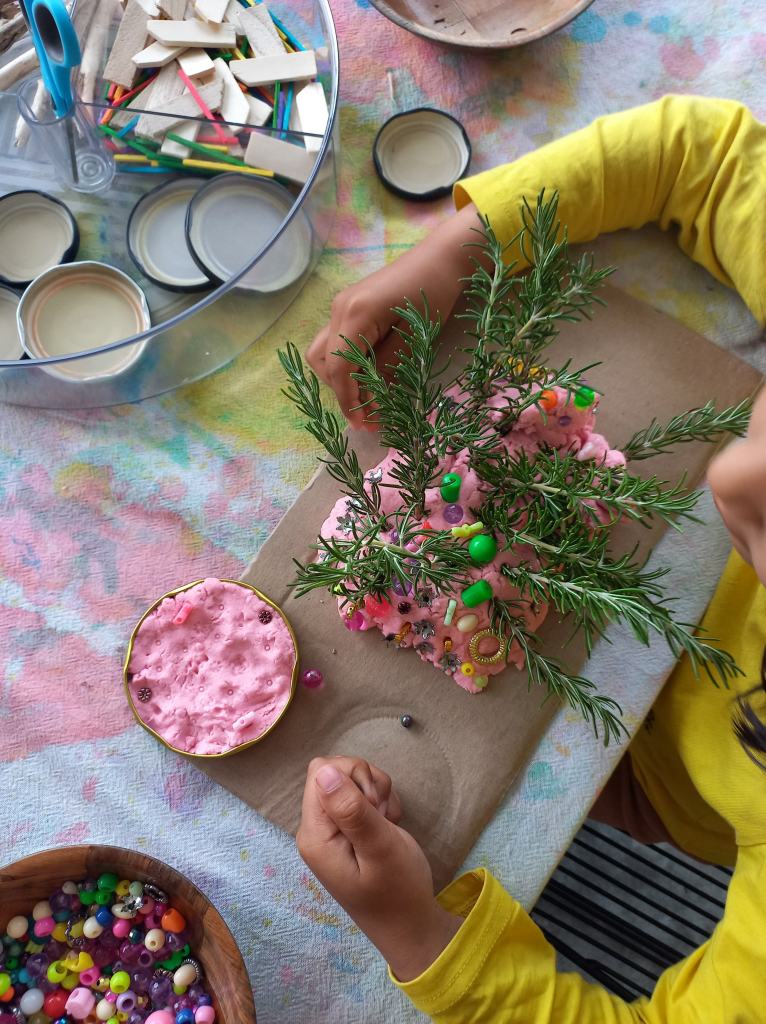
Both invitations to create allowed this young creative to tap into her imagination, encouraging her to make decisions, solve little creative puzzles, and express her unique perspective. At the age and stage L. is at, nurturing creativity, confidence, and the joy of exploration is key.
Technical art skills will develop naturally over time, but what’s most important now is giving her the freedom to experiment without the pressure of a final product. This approach not only supports her current developmental needs but also lays the groundwork for a lifelong love of art and creative expression – as well as healthy attitudes and habits for lifelong learning, transferable to other areas in her life.
I hope this gives you a clearer picture of our process-based approach. Please feel free to reach out if you have any questions or comments, always happy to chat all things art and play! 🌞
And with that, happy playing and creating,
Franzi x
 Imagine Play Inspire