Recently the question came up by one of our parents which open-ended toys I can recommend for 3-year-olds. I shared several popular options that not only guarantee to engage children in sustained periods of focused play but also often ‘grow’ with the child. Well, not literally of course (can you imagine… 🤣). But the point of open-ended toys is that they can be used in multiple ways, right? So, as your child’s needs and interests change over time, so does the way they use these same materials.
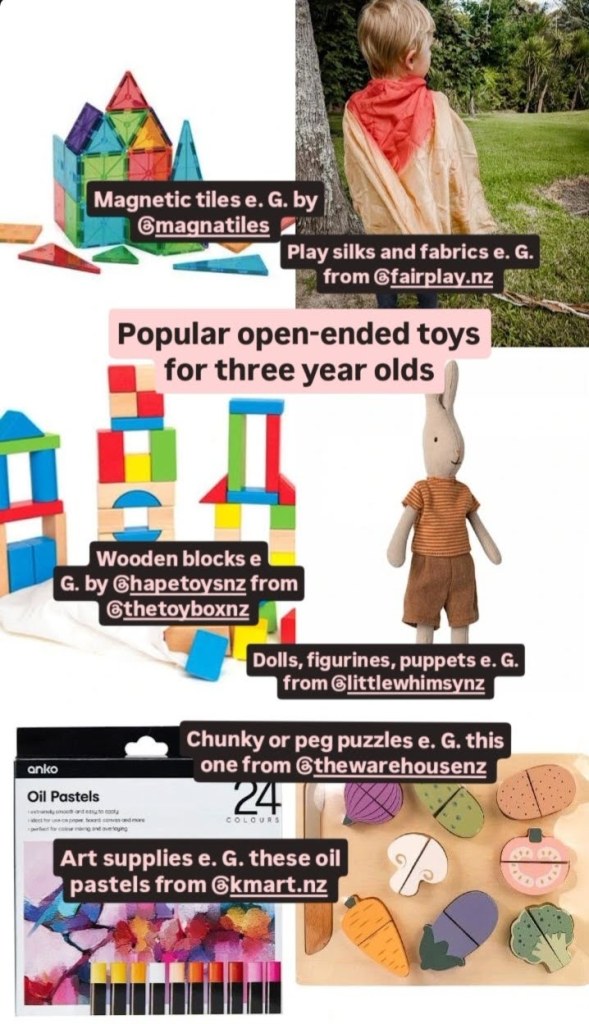
Let’s take the popular magnetic tiles as an example:
Let’s imagine your 2-year-old enjoys sorting, stacking, pushing, moving or simply touching the colourful pieces. More of a sensory experience at this stage, right? Now, fast forward a couple of years, and it’s very likely your now 4-year-old will use the same materials in quite a different way… Maybe they are building an animal enclosure, designing patterns on the floor, or perhaps they are using them as pretend food for their kitchen/family play. All things I have seen children do with these materials. All this, and more!
Open-ended toys allow children to imagine, problem-solve and create – based on their current needs and interests. Which is where the magic lies. Because when we let children follow their unique interests, they are so much more engaged in play & learning. There is plenty of research that supports this. And I have countless stories to tell of children absolutely thriving under these conditions (as well as plenty of stories where children don’t because structure & adult-direction take over).

Now, getting all these amazing resources costs money. Which, especially these days, we all want to spend less of, right? So instead of linking the products mentioned previously (see our story screenshot above), here are some low- or no-cost open-ended resources that invite creative, child-led play:
- smooth river stones for stacking, lining, sorting, painting (pay attention to the size if your child is mouthing)
- fabric scraps, small and large for dolls’ blankets, superhero capes, den building etc. (think old bedsheet, sarongs, ripped/old clothing) – PS: sheets are really fun to paint for kids, too! Hang over the fence or hedge outside and either use washable paint & brushes or spray bottles with diluted food colouring)
- wallpaper cut-offs or sample rolls (you can often pick these up for free at your local wallpaper shop [is that the name for it? 😅]) – great for collage work or large scale scribbling and painting (tip: cover the floor around it e.g. by putting down tarp or a drop sheet)
- driftwood – bigger pieces for hut building (pro tip: use rope to tie bits together), smaller ones for smaller scale building, crafting, lining up, sorting etc.
- shells – perfect for sorting by size or colour, lining up, printing in playdough (tip: give them a quick rinse and check for any sharp edges)
- cardboard boxes & tubes – show me a child who doesn’t like to play with cardboard boxes!
- bottle lids & jar tops – keep them in a sturdy container and let your child explore patterns. Here’s a fun idea: create mosaics on flat surfaces by taping a large shape using washi tape onto a tile, bench or floor, divide into sections and let them fill each section with the lids; fun to combine with other small loose parts!
- pinecones & seed pods – great for using with play- or salt-dough, threading onto string, sorting, pretend play (and the mosaic invitation above)
- buttons, beads & loose bits – My mum used to have these jars of mixed, loose buttons and my sisters and I LOVED rummaging through them!
- rope, leftover wool, old shoelaces – can be used for tying driftwood forts together, practising basic knots, or weaving
Now, this list is not just for 3-year-olds… The beauty of open-ended play is that older children too will find creative ways of using these materials, strengthening their imagination and creative thinking skills along the way. ‘Serve’ some of these open-ended resources with materials and tools allowing manipulation (glue, scissors, tape) and watch some focused play & problem-solving unfold!
Another tip to keep things novel & interesting for your young creators: just like books and other toys, rotate your open-ended resources and change what you offer alongside them. Keeps things fresh and sparks curiosity. 😊
And with that, happy playing and creating,
Franzi
 Imagine Play Inspire